
Last updated: 2026-10-10
Georgia HVAC Repair is an independent referral service that connects Georgia homeowners, landlords, and property managers with participating independent HVAC contractors. This page covers central air conditioning repair: the warning signs, the usual causes, the checks you can safely make yourself, and what to expect from a technician.
Warning signs your AC needs repair
- Warm or room-temperature air from the vents
- The outdoor unit hums but the fan doesn't spin, or nothing runs at all
- Weak airflow even with a clean filter
- The system turns on and off every few minutes (short cycling)
- Ice on the copper lines or the indoor coil
- Water around the indoor unit or a ceiling stain below an attic air handler
- Grinding, squealing, banging, or buzzing noises, or a burning smell
- Higher humidity indoors and a power bill that jumps for no clear reason
Common causes
Most AC repair calls trace back to a short list of failures:
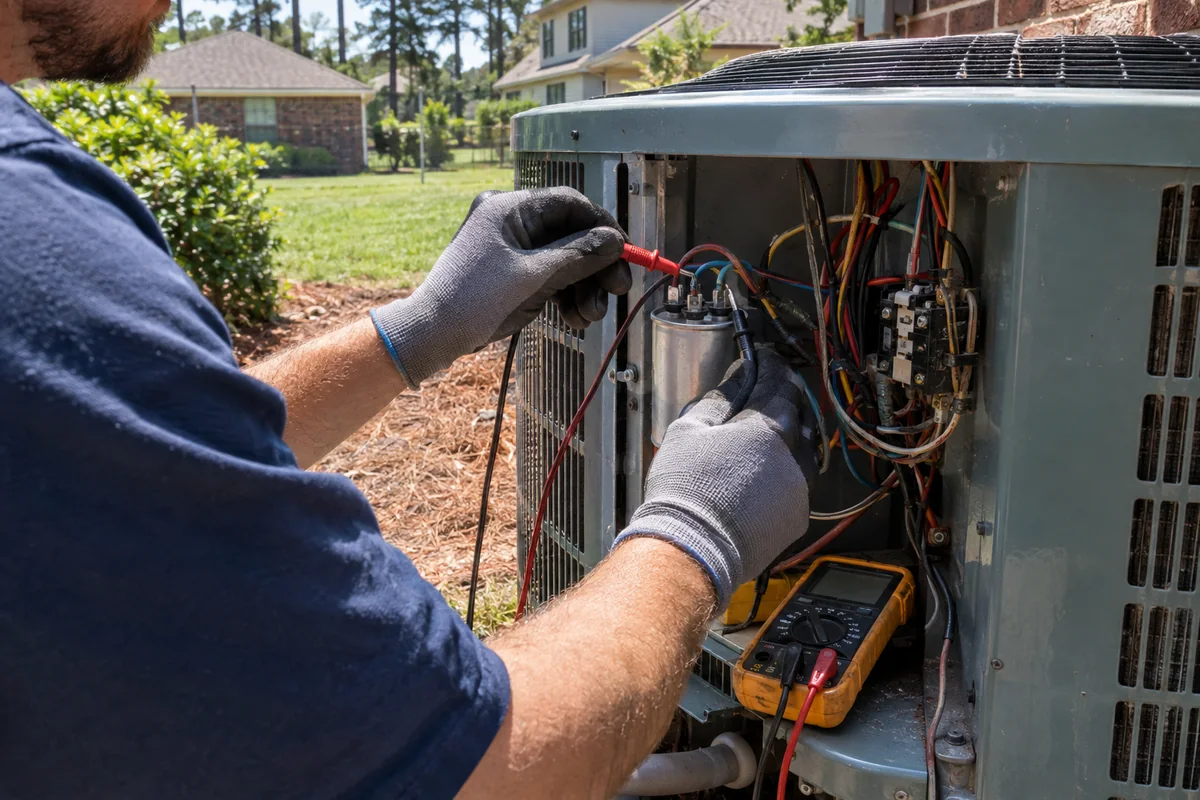
- Capacitor or contactor failure. These electrical parts start the compressor and fan motors and wear out with heat. A failed capacitor is one of the most common summer repairs.
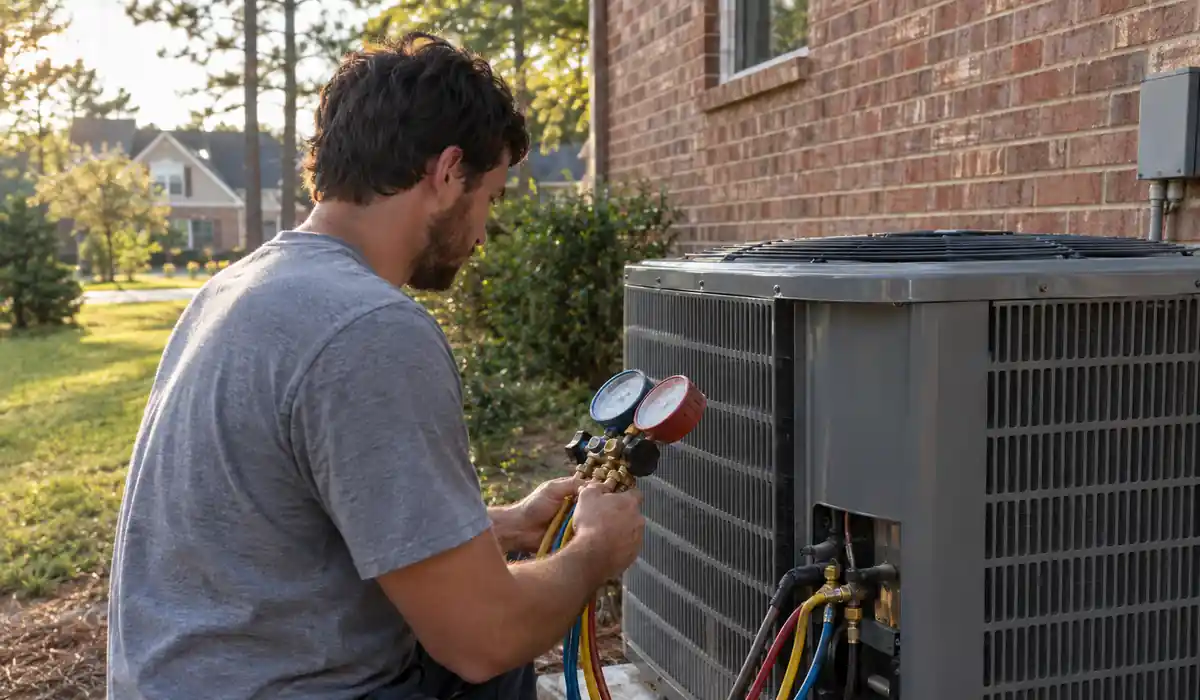
- Refrigerant leaks. Air conditioners don't use up refrigerant. If it's low, there's a leak. The EPA advises having a leak located and repaired rather than just topped off (EPA).
- Restricted airflow. A clogged filter, dirty evaporator coil, or failing blower motor can freeze the coil and cut cooling.
- Clogged condensate drain. Georgia humidity means air conditioners pull a lot of water out of the air. When the drain line clogs, water backs up and a safety switch may shut the system off.
- Thermostat problems. Dead batteries, wrong settings, or a failing thermostat can look like an AC failure.
- Compressor failure. The most expensive repair, and often the point where replacement becomes the better option on an older system.
Systems that use R-22 refrigerant
If your system was installed before about 2010, it may use R-22 (Freon). New R-22 hasn't been produced or imported in the U.S. since January 1, 2020. You can keep using and repairing an R-22 system, and technicians can service it with recycled or reclaimed R-22, but the EPA notes that supplies are limited and service costs may rise (EPA). That's a big factor in repair-versus-replace decisions for older Georgia homes.
When replacement may make more sense
There's no single age or dollar threshold that applies to every home, but these factors push toward replacement: an older system needing a major repair like a compressor or coil, a system that uses R-22 and has a refrigerant leak, repeated repairs in recent seasons, rooms that never cool evenly, and high power bills. Our AC repair or replace calculator lays out the factors for your own system, and AC replacement explains what a new system involves.
When to call an HVAC professional
- The breaker trips again after you reset it
- The outdoor fan isn't spinning while the unit hums
- There's ice on the lines or coil, or it comes back after thawing
- You smell burning or hear grinding or banging
- Water keeps collecting around the indoor unit
- Anything involving refrigerant, electrical parts, or gas: these require a technician (refrigerant work requires EPA Section 608 certification)
What AC repair costs
HomeAdvisor's 2026 data puts the typical AC repair at $172 to $664, averaging about $417, with diagnostic or service-call fees of $75 to $200 (HomeAdvisor, 2026). Common repairs: capacitor $120–$475, refrigerant recharge $100–$600, refrigerant leak repair $225–$1,600, evaporator coil $600–$2,000, and compressor replacement $1,200–$2,800. After-hours service runs about $160–$250 an hour versus $75–$150 during business hours. See our Georgia AC repair cost guide for the full breakdown.
- The failed part: a capacitor versus a compressor
- Refrigerant type and amount (R-22 costs more)
- System age and access, such as an attic air handler
- Time of day: evenings, weekends, and heat waves cost more
Safe checks before you call
- Thermostat: set to Cool, set below the room temperature, fresh batteries.
- Breakers: check the AC and air handler breakers in the panel. Reset once; if it trips again, stop and call.
- Filter: replace a dirty filter. A clogged filter is one of the most common causes of poor cooling and frozen coils.
- Outdoor unit: clear leaves, grass clippings, and anything within a couple of feet. Don't open the panel.
- Ice: if the lines or coil are frozen, turn cooling off and run the fan to thaw it before a technician arrives.
- Water: if the condensate pan is full or a float switch has shut the system off, turn the system off and call. Don't run it with water overflowing.
Questions to ask the contractor
- Do you hold a current Georgia conditioned air contractor license?
- What's the diagnostic fee, and is it credited toward the repair?
- What exactly failed, and can you show me?
- If refrigerant is low, where is the leak and will you repair it, not just recharge it?
- Given my system's age, would you repair it or replace it, and why?
- What warranty covers the parts and labor?