
Decision Guide
Should you repair or replace your air conditioner?
How to decide between repairing and replacing your AC: system age, the size of the repair, refrigerant type, efficiency, comfort, and repair history, with costs and sources.
There's no single rule. Weigh the system's age, how big the repair is, the refrigerant it uses, your power bills and comfort, and how often it has needed repairs. ENERGY STAR suggests considering replacement if an air conditioner is more than 10 years old or needs frequent repairs. A small repair on a younger system is usually worth it.
Published 2026-10-10 · Updated 2026-10-10
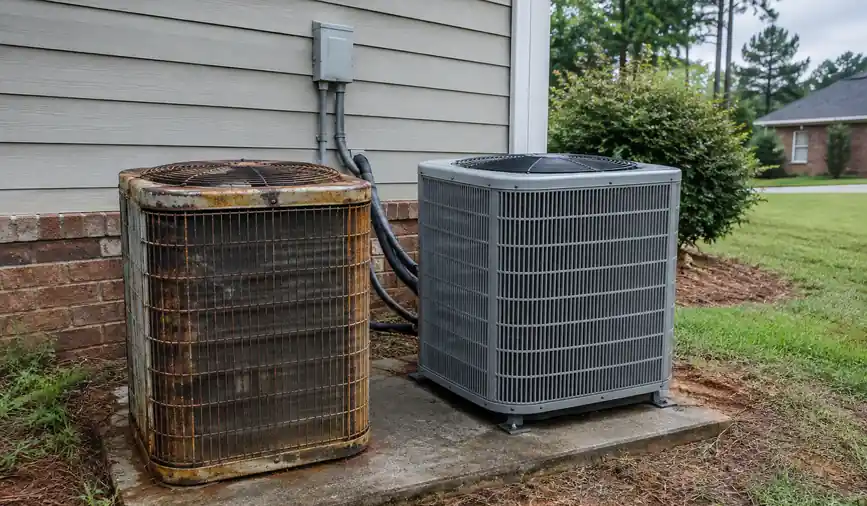
Georgia HVAC Repair is an independent referral service that connects Georgia homeowners with participating independent HVAC contractors. Repair-or-replace is one of the biggest decisions a homeowner makes about their home, and the right answer depends on your specific system. Here are the factors that matter, with sources.
Want to weigh your own system? Try the AC repair or replace calculator.
The six factors
1. Age
ENERGY STAR suggests considering replacement if your air conditioner or heat pump is more than 10 years old or needs frequent repairs. Age alone doesn’t mean replace. A well-maintained 12-year-old system with a $200 capacitor failure is still usually worth repairing.
2. The size of the repair
| Repair | Typical cost |
|---|---|
| Capacitor | $120 – $475 |
| Refrigerant leak repair | $225 – $1,600 |
| Evaporator coil | $600 – $2,000 |
| Compressor | $1,200 – $2,800 |
| New central AC (installed) | $3,887 – $8,073 (avg. $5,978) |
Sources: HomeAdvisor repair and installation cost data.
Small electrical repairs are almost always worth doing. Compressor and coil failures on an older system are where replacement usually comes into the conversation.
3. Refrigerant
New R-22 hasn’t been produced or imported in the U.S. since January 1, 2020. The EPA says R-22 systems can still be used and serviced with reclaimed refrigerant, but supplies are limited and costs may rise. A refrigerant leak in an R-22 system is one of the strongest reasons to replace.
4. Efficiency and power bills
Since January 1, 2023, new split-system central ACs sold in Georgia must meet at least 14.3 SEER2 (U.S. Department of Energy). ENERGY STAR says properly installed certified equipment can save up to 20% on heating and cooling costs. If your bills keep climbing, efficiency is part of the math.
5. Comfort and sizing
Rooms that never cool, a house that feels clammy, or a system that short cycles can mean the system is the wrong size for the house. Sometimes the ductwork is the problem instead. A replacement is a chance to get sizing right with a load calculation, but only if the contractor does one.
6. Repair history
One repair in ten years is normal. Repeated repairs in recent seasons add up in cost and inconvenience, and ENERGY STAR lists frequent repairs as a reason to consider replacement.
Questions to ask the contractor
- What failed, and is it likely to fail again soon?
- What refrigerant does my system use?
- If I replace, what size do you recommend, and did you do a load calculation?
- Should I replace the indoor coil or air handler too?
- What warranty comes with the repair, and with a new system?
Getting a second opinion on a major repair is reasonable, especially if the recommendation is replacement. See AC replacement for what a new system involves.
The bottom line
If you have an HVAC problem now, call (770) 679-7684 and we'll try to connect you with a participating independent HVAC contractor who serves your area. That HVAC contractor diagnoses the problem and quotes the job themselves.