
Learn
Why is my air conditioner blowing warm air?
The common reasons an AC blows warm air: thermostat settings, a dirty filter, a tripped breaker, a frozen coil, a failed capacitor or fan, low refrigerant. What to check and when to call.
The most common causes are a thermostat set to the wrong mode, a clogged filter, a tripped breaker, a frozen evaporator coil, a failed capacitor or outdoor fan motor, or low refrigerant from a leak. Check the thermostat, filter, and breakers yourself. If the outdoor fan isn't spinning or there's ice on the lines, call a technician.
Published 2026-10-10 · Updated 2026-10-10
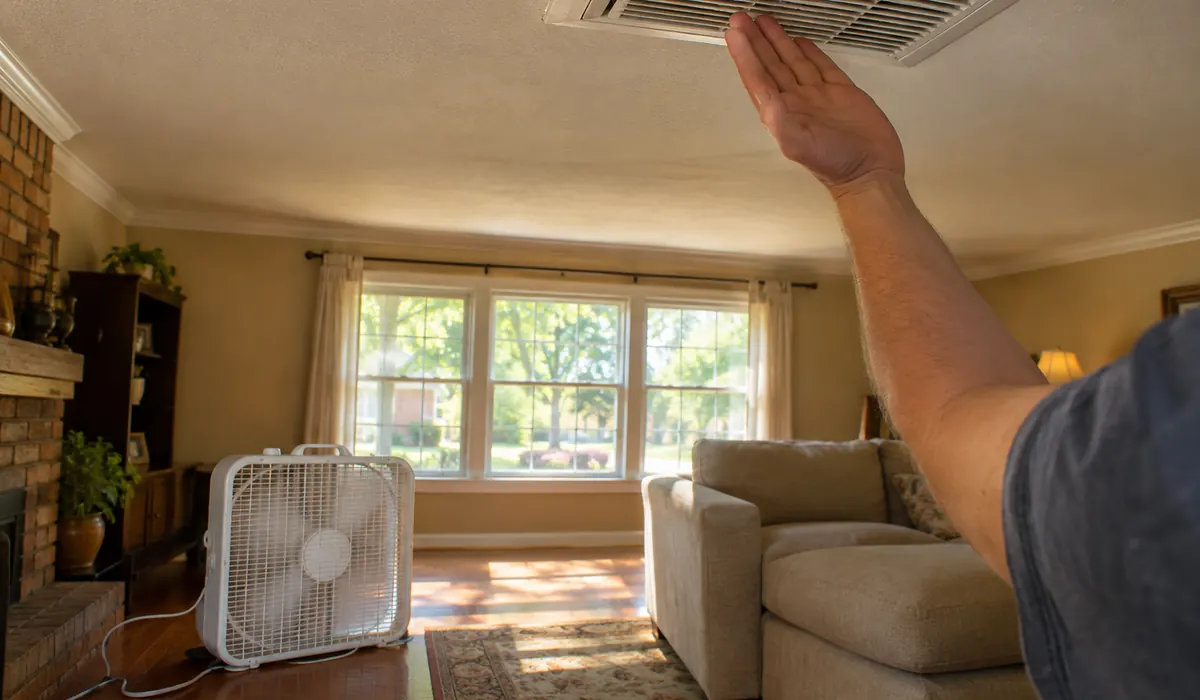
Georgia HVAC Repair is an independent referral service that connects Georgia homeowners with participating independent HVAC contractors. When your AC blows warm air in the middle of a Georgia summer, work through the causes below, starting with the ones you can safely check yourself.
Causes you can check yourself
1. Thermostat settings
Make sure the thermostat is set to Cool, the temperature is set below the current room temperature, and the fan is on Auto. If the fan is set to On, it keeps blowing even when the AC isn’t cooling, which feels like warm air. Replace the batteries if the display is dim or blank.
2. A clogged air filter
A dirty filter chokes airflow over the indoor coil. Cooling drops, and the coil can freeze. Replace the filter and check it monthly during the cooling season.
3. A tripped breaker
Many systems have two breakers, one for the outdoor unit and one for the indoor air handler or furnace. If the outdoor breaker trips, the indoor fan keeps blowing room-temperature air. Reset it once. If it trips again, leave it off and call a technician; there’s an electrical fault.
4. The outdoor unit is blocked or dirty
The outdoor unit sheds the heat pulled out of your house. Leaves, grass clippings, and overgrown shrubs block it. Clear a couple of feet around it. Don’t open the panel.
Causes that need a technician
5. A frozen evaporator coil
Ice on the copper lines or the indoor coil means the coil got too cold, usually from restricted airflow or low refrigerant. Turn cooling off and run the fan to thaw it. If it freezes again after you’ve replaced the filter, call for service.
6. A failed capacitor or contactor
These electrical parts start the compressor and outdoor fan, and they wear out with summer heat. A classic sign is an outdoor unit that hums but the fan doesn’t spin. HomeAdvisor’s 2026 data puts a capacitor repair at $120–$475 (HomeAdvisor). Capacitors store a charge even with the power off, so leave this one to a technician.
7. Low refrigerant (a leak)
Air conditioners don’t use up refrigerant. If it’s low, there’s a leak. The EPA advises having a leak located and repaired rather than just recharged. HomeAdvisor lists refrigerant recharges at $100–$600 and leak repairs at $225–$1,600. If your system uses R-22, which hasn’t been produced since 2020, refrigerant repairs cost more, and the repair-or-replace question gets serious.
8. A failing compressor
The compressor is the heart of the system. Compressor replacement runs $1,200–$2,800 per HomeAdvisor, and on an older system that’s often the point where replacement makes more sense. Our repair or replace calculator can help you weigh it.
9. A clogged condensate drain
In humid Georgia summers, air conditioners pull a lot of water out of the air. If the drain clogs, a float switch may shut off the cooling while the fan keeps running. If you see water in the pan or around the unit, turn the system off and call.
When to call
Call an HVAC technician if:
- The outdoor fan isn’t spinning
- The breaker trips again after one reset
- There’s ice that returns after thawing
- You smell burning or hear grinding
- Water is collecting around the indoor unit
See AC repair for what a repair visit involves, or find local help in Marietta, Macon, and other Georgia service areas.
The bottom line
If you have an HVAC problem now, call (770) 679-7684 and we'll try to connect you with a participating independent HVAC contractor who serves your area. That HVAC contractor diagnoses the problem and quotes the job themselves.