Skip to content

Independent referral service: calls connect you with participating Georgia HVAC contractors. How it works

Georgia HVAC Repair

New central air systems

AC Replacement in Georgia

When a repair stops making sense, replacement is a big purchase. What drives the price, what efficiency rules apply in Georgia, and how to make sure a new system is sized right.

(770) 679-7684 · Referral to a participating independent HVAC contractor

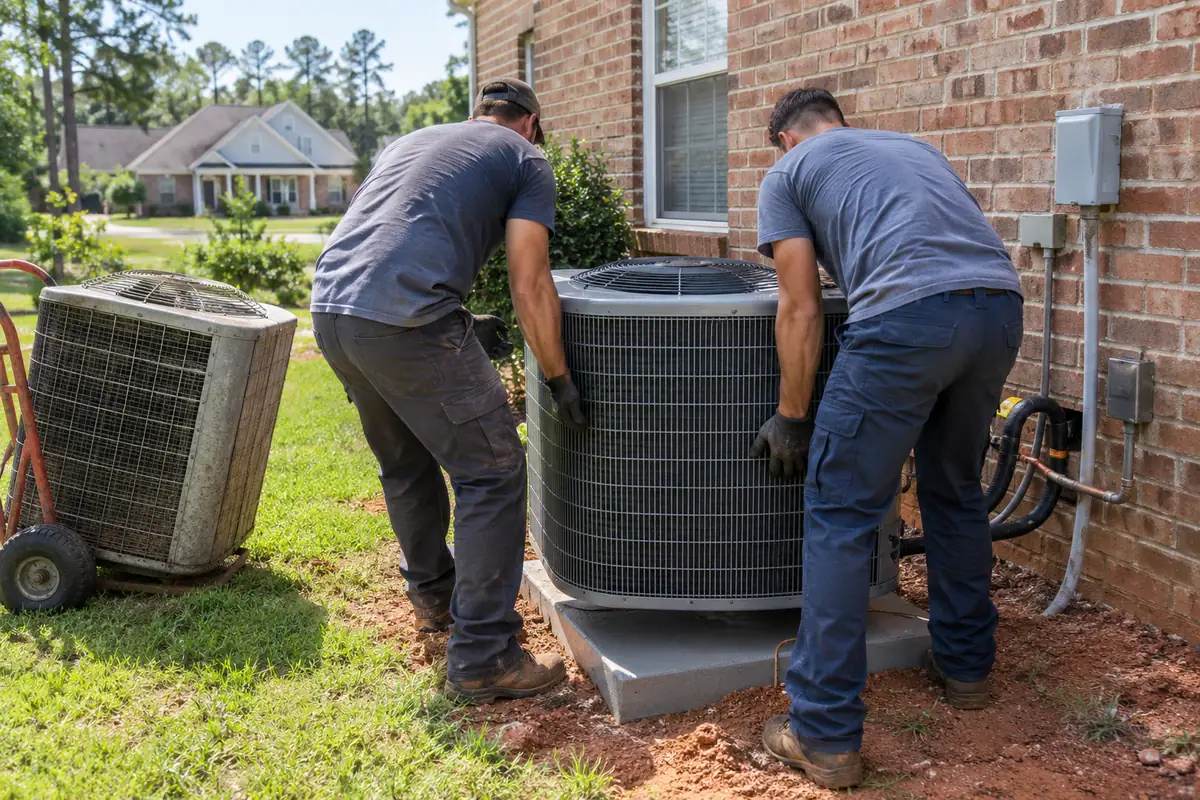
New outdoor AC condenser being set on a pad beside a Georgia home

Last updated: 2026-10-10

Georgia HVAC Repair is an independent referral service that connects Georgia homeowners with participating independent HVAC contractors, including for system replacement. Not every participating contractor installs new systems, so confirm when you're connected. This page explains what goes into an AC replacement and how to compare quotes.

When replacement makes sense

ENERGY STAR suggests considering replacement if your air conditioner or heat pump is more than 10 years old or needs frequent repairs, and says properly installed ENERGY STAR equipment can save up to 20% on heating and cooling costs (ENERGY STAR). A major repair, like a compressor or coil, on an older system, or a refrigerant leak in an R-22 system, are common tipping points. Our repair or replace calculator lays out the factors for your system.

Efficiency rules in Georgia

Georgia is in the Department of Energy's Southeast region. Since January 1, 2023, new split-system central air conditioners under 45,000 BTU (about 3.75 tons) must meet at least 14.3 SEER2 here, and new split-system heat pumps must meet 14.3 SEER2 nationwide (U.S. Department of Energy). Higher-efficiency systems cost more up front and less to run.

Refrigerant is changing

Older systems used R-22, which hasn't been produced in the U.S. since 2020 (EPA). Most systems installed in recent years use R-410A, and new systems are moving to lower-global-warming refrigerants such as R-454B and R-32 under EPA rules that were revised in 2026. Ask each contractor which refrigerant the quoted system uses and how that affects future service.

Sizing matters

A bigger system isn't better. An oversized AC cools quickly but shuts off before it removes humidity, leaving a Georgia home cold and clammy, and it short cycles. Proper sizing uses a load calculation (Manual J) based on the home's size, insulation, windows, and orientation, not just the size of the old unit. Ask whether the contractor does one.

Signs it may be time to replace

  • The system is more than 10 years old and needs a major repair
  • An R-22 system has a refrigerant leak
  • Repairs in multiple recent seasons
  • Rising power bills and uneven comfort
  • The house never feels dry in summer

What AC replacement costs

HomeAdvisor puts central AC installation at $3,887–$8,073, averaging about $5,978 (HomeAdvisor). The unit alone runs roughly $2,900–$9,000 depending on size and efficiency.

  • System size (tonnage) and efficiency (SEER2)
  • Whether the indoor coil, air handler, or furnace is replaced too
  • Ductwork changes
  • Permits and electrical updates
  • Brand and warranty
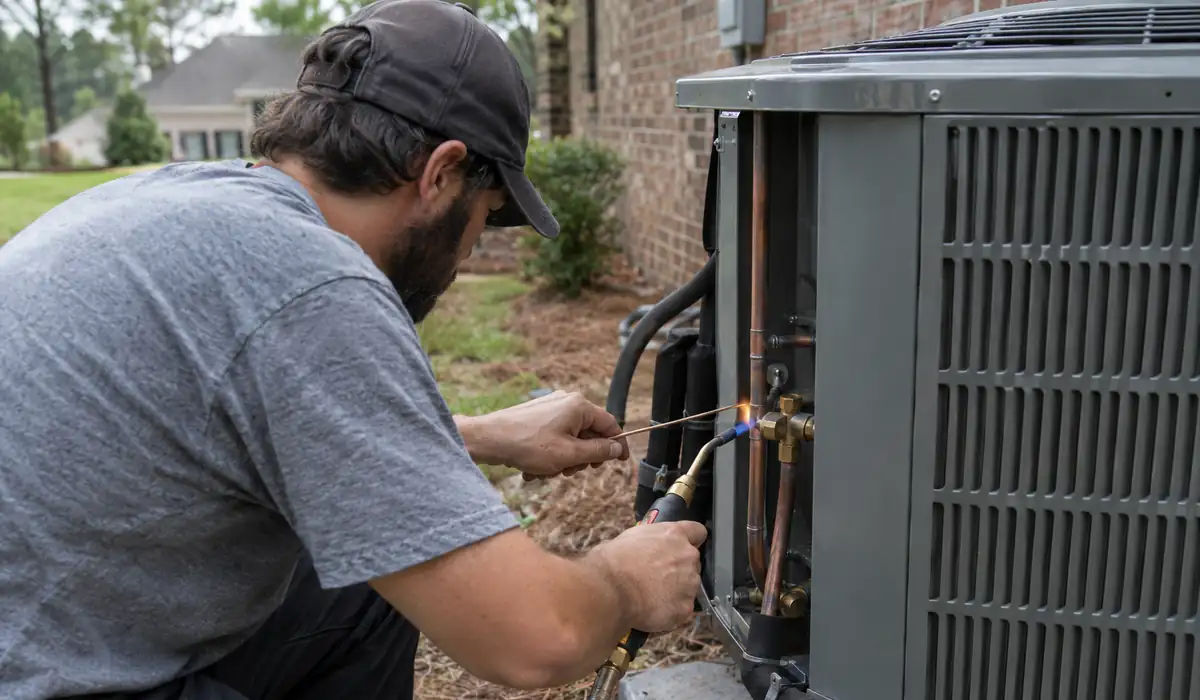
Technician connecting refrigerant lines to a new outdoor AC unit

How to compare replacement quotes

  1. Get two or three written quotes from licensed contractors.
  2. Compare the same thing: size, SEER2 rating, whether the indoor coil is included, and the refrigerant.
  3. Ask about a load calculation instead of matching the old unit's size.
  4. Ask who pulls the permit; replacements generally require one.
  5. Get the warranty terms for equipment and labor in writing.

Questions to ask the contractor

  • Do you hold a current Georgia conditioned air contractor license?
  • What's the diagnostic fee, and is it credited toward the repair?
  • Will you give me the diagnosis and price in writing before you start?
  • Did you do a load calculation, and what size does it call for?
  • Does the quote include a matched indoor coil or air handler?
  • Which refrigerant does this system use?
  • Who pulls the permit, and is it included?

Related HVAC guides

Straight comparison

What you can safely check vs. what needs a technician

SymptomSafe to check yourselfCall an HVAC technician
AC won't turn onThermostat set to cool and below room temperature, batteries, breaker, the outdoor disconnect switchBreaker trips again, humming outdoor unit with a stopped fan, burning smell
Blowing warm airThermostat setting, a clogged filter, the outdoor unit blocked by debrisOutdoor fan or compressor not running, ice on the lines, warm air with a clean filter
Weak airflowReplace the filter, open closed supply ventsFrozen coil, failing blower motor, disconnected ductwork
Water around the indoor unitTurn the system off, check the condensate drain pan and float switchClogged condensate line, cracked pan, frozen evaporator coil
Ice on the lines or coilTurn cooling off and run the fan to thaw it; change the filterLow refrigerant (a leak), airflow or blower problems
Refrigerant, electrical, or gas workNot DIYRefrigerant handling requires EPA Section 608 certification; electrical and gas repairs need a licensed contractor

What to expect

What happens during an HVAC service call

  1. Questions and a quick check

    The technician asks what you have noticed (warm air, noises, ice, water, short cycling) and checks the thermostat, breaker, and filter before opening the equipment.

  2. Diagnosis

    Electrical tests on the capacitor, contactor, and motors, a look at the coils and drain, and refrigerant pressure readings where needed. Diagnostic or service-call fees commonly run $75 to $200.

  3. Price before the repair

    You should get the diagnosis and a price before work starts, and for an older system, an honest note on whether repair or replacement makes more sense.

  4. Repair

    Common parts like capacitors and contactors are often replaced the same visit. Refrigerant leak repair, compressors, and coils may need parts ordered or a return trip.

  5. Test and paperwork

    The system is run and temperatures checked. You get an invoice listing parts, labor, any refrigerant added, and warranty terms.

How the referral works

How our HVAC contractor-matching service works

  1. You call the number on this site

    Have the property's address or ZIP code ready, plus a short description: AC blowing warm air, no heat, water leaking, strange noises.

  2. Your call is routed to a participating contractor

    Your call is connected with a participating independent HVAC service provider who serves your area, if one is available. We do not send a technician ourselves.

  3. You deal with that contractor directly

    The contractor diagnoses the system, quotes the repair, and does the work under their own business name, license, and insurance. You decide whether to hire them; there is no obligation.

Good to know: availability depends on which participating contractors cover your ZIP code and how busy they are, especially during summer heat waves, and not every contractor offers every service. Ask about their Georgia conditioned air license, insurance, written price, and timeline before work starts. Our HVAC guides cover what to ask.

Request Heating or Cooling Assistance

Call and we will try to connect you with a participating independent HVAC contractor who serves your area.

Questions

AC Replacement questions

How much does a new central AC cost in Georgia?

HomeAdvisor puts central AC installation at $3,887–$8,073, averaging about $5,978. Size, efficiency, indoor equipment, ductwork, and permits all change the price. Get written quotes from licensed contractors.

What SEER2 rating is required in Georgia?

Since January 1, 2023, new split-system central ACs under 45,000 BTU sold in the Southeast region, including Georgia, must be at least 14.3 SEER2, per the U.S. Department of Energy. Split-system heat pumps must be at least 14.3 SEER2 nationwide.

Should I replace my AC and furnace together?

Often, if both are older, because the indoor coil sits on the furnace and matched systems perform best. A contractor can tell you whether your furnace has useful life left.

Does Georgia HVAC Repair do the work?

No. Georgia HVAC Repair is an independent referral service. Your call is connected with a participating independent HVAC contractor who serves your area, if one is available, and that contractor does the work.

Call (770) 679-7684 · Get Help